A Dental Article Critique
This is an article critique for “Association Between Duration of Breastfeeding and Malocclusion in Primary Dentition in Brazil” that has been but together by: Lopes et al. 2019 Journal of Dentistry for Children which was presented in Pure Dentistry Dentist in Mt Gravatt, Brisbane
Breast Feeding Recap
- Indirect pulp treatment was independent of capping material and success relies on appropriate case selection, correct diagnosis and adequate marginal seal.
Gurcan et al. 2019 - Improvement in childs OHRQof dropped 44.5% from base line to follow up after dental rehab under GA
Hammunda et al. 2019
Introduction
1.non-nutritive sucking habits
2.poor eating habits such as soft diet
3.prolonged use of feeding bottles
4.respiratory problems
5.tongue posture
6.ECC
Changes in normal primary dentition can cause abnormalities in permanent dentition
Rochelle et al. 2010
Breastfeeding
Appropriate tonus and development of muscles of mastication
Correct establishment of functions of the oral cavity
Romero et al. 2011
Absence of breast feeding/early weaning
Chewing, swallowing, breathing and speech problems
More chances of harmful sucking habits
Gimenez et al. 2008, Carrascoza et al. 2006
Some studies show positive relationship between breastfeeding and prevention of malocclusion
Bueno et al. 2010, Romero et al. 2011
One study has questioned the association
Aznar et al. 2006
Purpose of the Study
The purpose of this study was to investigate the association between breastfeeding type (exclusive or associated with formula) and duration, and the development of malocclusion in primary dentition.
Study Results
Over 72% did not present with non-nutritive sucking habits
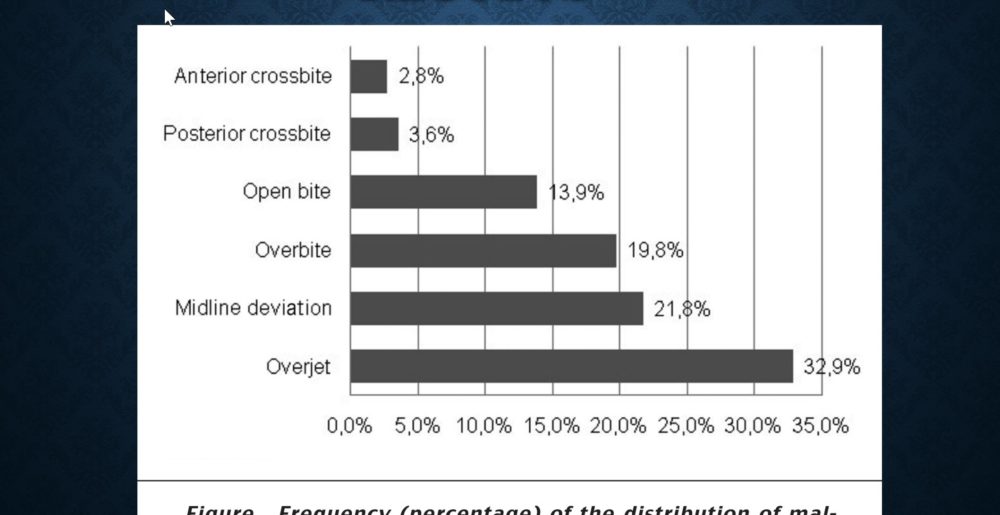
Prevalence of malocclusion was 45.6%
Non-nutritive sucking habits:
Nail biting 21.8% (does not effect breast feeding)
Pacifier use 20.2 %
Finger sucking 7.8%
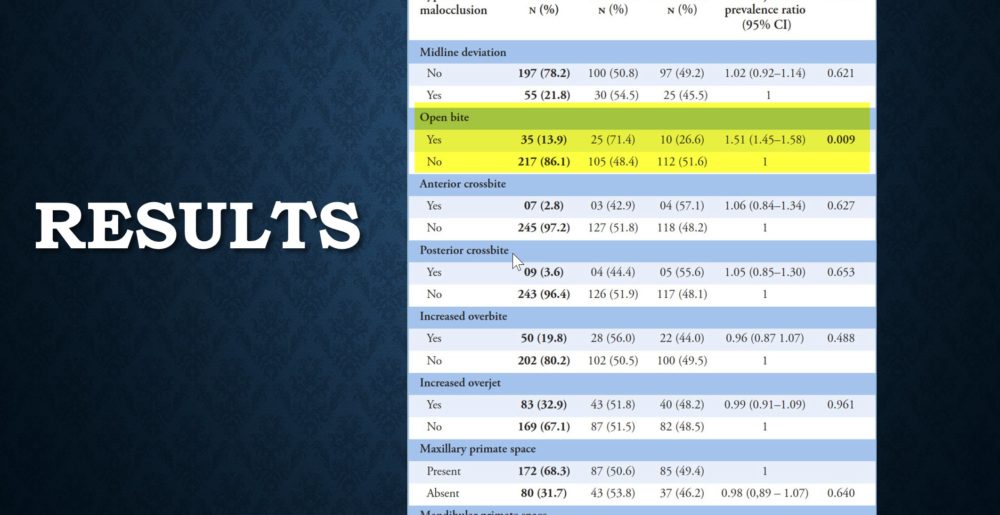
EBF for less than six months had a higher prevalence of anterior open bite than children exclusively breastfed for more than six months
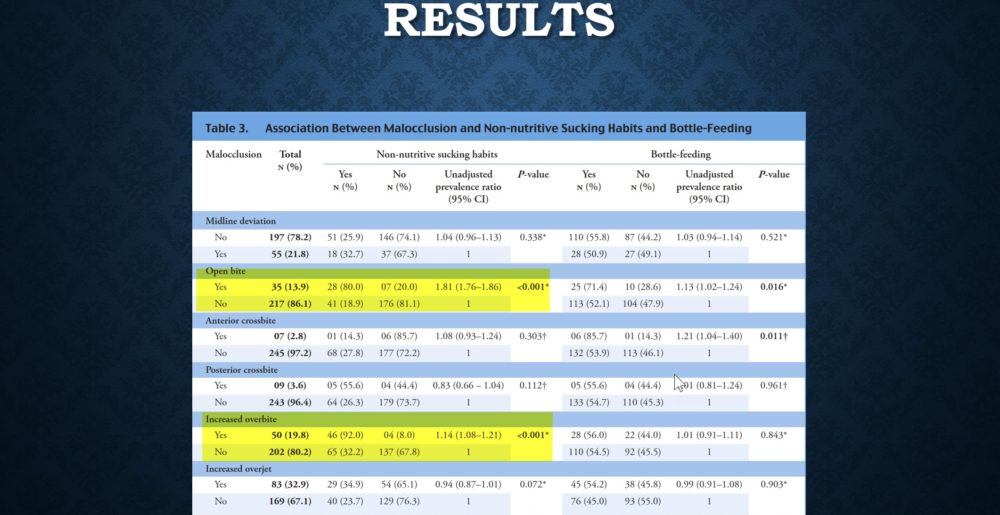
children with non-nutritive sucking habits had a higher prevalence of anterior open bite and overbite compared to those who did not manifest such habits.
Use of bottle had a higher prevalence of anterior open bite compared to the children who did not use it.
Method of the Study
cross-sectional observational study
n=252 (55.2%boys and 44.8%girls- 30-48 months)
part of preventive program for pregnant women and babies (PPGB)
Inclusion/ exclusion criteria
Ethics approval (The ethics committee the Federal University of Piauí, Teresina, Piauí, Brazil.)
Pilot study on 20 children and mothers
Intra-examiner Kappa = 0.80
Data collection between April 2010 and July 2011
Semi structured questionnaire
Knee- to-knee position by paediatric dentist
Following definitions of breast- feeding categories (WHO)
Exclusive breastfeeding (EBF)
Complementary feeding (CF)
Bottle-feeding
Midline relationship, anterior open bite, posterior crossbite, and overbite and overjet relationships evaluated using Emmerich et al methodology
Emmerich et al. 2004
Midline was diagnosed by clinical static display and observing the positioning of the dental midline in relation to adjacent teeth and in relation to the face size without deviation in size
Burstone et al. 1998
Discussion
Pathogenesis of malocclusion is multifactorial and result of interaction between genetic and environmental factors including the orofacial anatomy, breathing, swallowing and speech
Ozvenik et al. 2009
Difficult to evaluate effects of breast feeding on the orofacial muscle due to difficulty separating hereditary factors and environmental factors such as nutritive and non-nutritive habits
Chen X et al. 2015
High prevalence of malocclusion in primary dentition 50%-95%
Rochelle et al. 2010, Gimenez et al. 2008, Carrascoza et al. 2006
High prevalence of malocclusion also seen in this study but with lower percentage
Emmerich et al. 2004, Moimaz et al. 2013
Comparing the prevalence of malocclusion with other studies is complex
different research protocols
different number and variables analyzed
different parameters used to classify type of malocclusion
Factors relevant to lack of association between type and duration of breast feeding and malocclusion in this study was due to low incidence of use of pacifiers and finger sucking habits which brings benefits
Kobayashi et al. 2010, Chen X et al. 2015
Low percentages of occlusal changes in this study
all children part of PPGB/ caregivers educated
all participants were breast fed in this study
almost half the children received EBF until 6 month of age and older
Prolonged breastfeeding was considered a protective factor for anterior open bite, a fact confirmed by other authors
Moimaz et al. 2013
Similar results of this study to other studies for children that were breast fed for 6 months and did not use a pacifier
Kobayashi et al. 2010, Gimenez et al. 2008
Non-nutritive sucking habits
Pacifier the biggest risk factor for:
discontinuing EBF
anterior overbite
posterior crossbite
anterior overjet
Romero et al. 2011, Gimenez et al. 2008
Persistence of habit duration over 18 months more dangerous
Rochelle et al. 2010, Gimenez et al. 2008, Melink et al. 2010, Massuia et al. 2011
Finger sucking for more than 48 months higher prevalence of anterior open bite, posterior cross bite and increased overjet
Bishara et al. 2006
Nail biting
Most prevalent non-nutritive habit, does not effect breastfeeding
can be a symptom of emotional stress
20-60% prevalence in the common population
Figueira et al. 2002
Bottle feeding
Justified theoretically by various mechanisms associated with bottle feeding and development of malocclusion
Chen et al. 2015
A bottle requires less muscle activity to obtain the milk, resulting in lower development of muscles involved in the suction; this may contribute to insufficient mandibular growth
Romero et al. 2011
Bottle feeding
Tongue controls the milk flowing in this process, which increases the prevalence of atypical swallowing.
Stanley et al.1980
Bottle feeding increase the chances of mouth breathing, which could compromise the occlusion
Carrascoza et al. 2006
Present study showed significant malocclusion such as anterior open bite and anterior cross bite for children who used a bottle if the type and duration of breastfeeding was not considered, confirming the findings in the literature.
Romero et al. 2011, Melink et al. 2010, Chen X et al. 2015
Midline Asymmetry
orthopetic asymmetry of the upper cervical spine
Korbamcher H et al. 2007
functional deviation of the mandible.
Brin I et al. 1996
position of TMJ
Liu C et al. 2007
Lack of literature about midline deviation in primary dentition
in this study midline deviation is second most observed occlusal abnormality
Conclusion
The prevalence of malocclusion and harmful habits in the study population was low
Exclusive breastfeeding for a period less than six months was associated with the development of anterior open bite
Critique
TITLE
could have included non-nutritive sucking habits
cross sectional study
ABSTRACT
good overview of the paper
results and conclusion well presented
INTRODUCTION
over view of possible aetiology of malocclusion
benefits of breastfeeding
outlined different views
Anzar’s study not used correctly as a questionable study
Bueno’s study
METHOD
type of study ( cross sectional- observational)
clear calculation of sample size(10% more incase of sample loss)
inclusion and exclusion criteria
intra-examiner Kappa 0.8
sample bias
RESULT
72 percent of children didn’t have non nutritive sucking habits
doesn’t specify what sort of habit (pacifier, digit sucking) and duration
interesting there is open bite and deep bite at higher prevalence with non-nutritive sucking habits
Conclusion and take home message
Conclusion consistent with the aim of study
Exclusive breastfeeding less than 6 months may be associated with malocclusion
Various factors involved in malocclusion so very hard to find association with cross sectional studies